
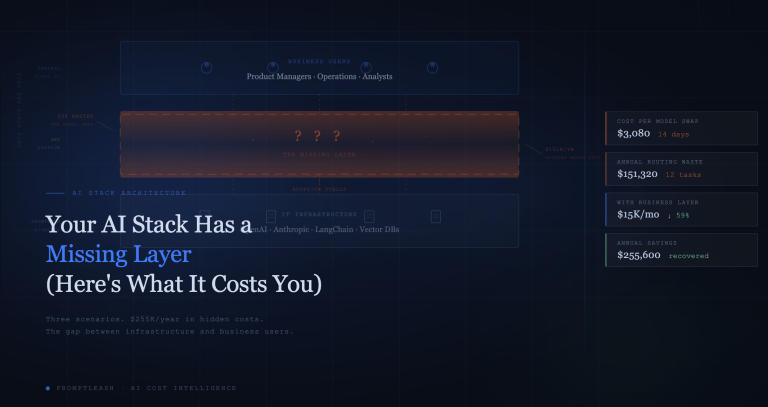
Your AI Stack Has a Missing Layer (Here’s What It Costs You)
Imagine you’re running a shipping company. You’ve got the trucks. You’ve got the warehouses. You’ve got a fleet management system that tracks fuel consumption down to the liter. But every time a customer wants to ship a package, they have to walk into the warehouse, find a truck driver, negotiate which vehicle to use, and manually check the fuel costs themselves. That’s how most enterprises run AI today. The infrastructure layer is impressive. LLM providers,
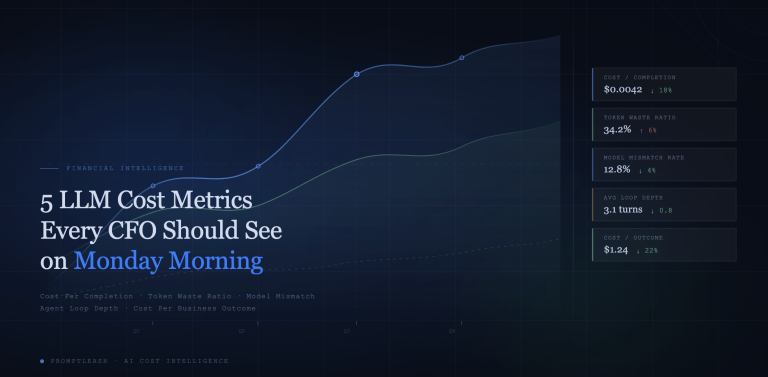
5 LLM Cost Metrics Every CFO Should See on Monday Morning
Your CFO can tell you, to the cent, what the company spent on cloud infrastructure last quarter. They can break down headcount costs by department, software licenses by vendor, and travel expenses by region. Ask them what the company spent on AI last month, and you will likely get a blank stare, or worse, a confident answer that is catastrophically wrong. This is not their fault. The tooling does not exist in most organisations to
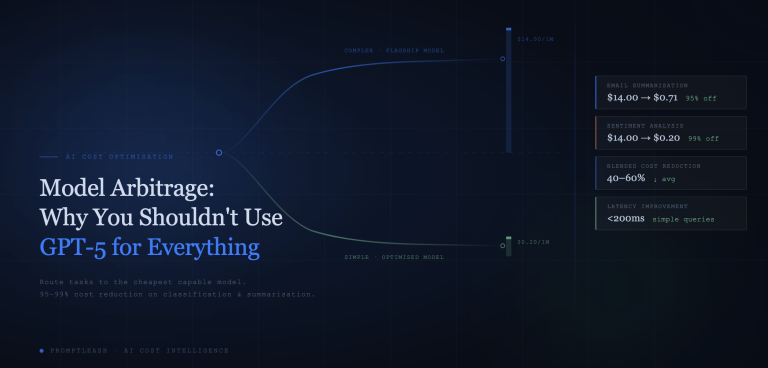
Model Arbitrage: Why You Shouldn’t Use GPT-5 for Everything
Imagine hiring a Nobel Prize-winning mathematician to sit in a restaurant and calculate a 15% tip on a $40 lunch bill. They would get the answer right, certainly. But you would be paying hundreds of dollars an hour for a task that a $5 pocket calculator could do instantly for free. This sounds absurd, yet it is exactly what 90% of enterprise engineering teams are doing right now. We are suffering from an epidemic of “Model
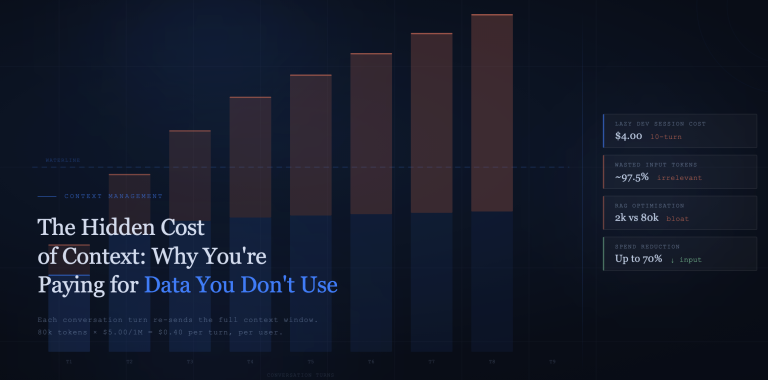
The Hidden Cost of Context: Why You’re Paying Too Much for Data You Don’t Use
In the current landscape of Large Language Model (LLM) development, we are witnessing a frenetic “feature race” centered on one specific metric: context window size. A year ago, 32k tokens felt revolutionary. Today, providers like OpenAI, Google, and Anthropic are normalizing windows of 128k, 200k, and even 1 million tokens. For AI engineers and architects, this sounds like a dream scenario. The days of complex chunking strategies and agonizing over what data to exclude from
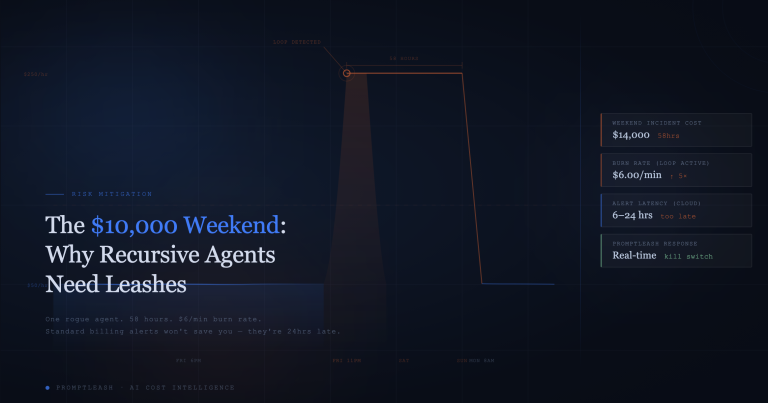
The $10,000 Weekend: Why Recursive Agents Need Leashes
It was 8:45 AM on a Monday. David, a Lead Infrastructure Engineer at a mid-sized fintech company, settled in with his coffee and opened his cloud billing dashboard—a routine habit he’d formed years ago. Usually, the graph was a flat, predictable line. Maybe a small bump during end-of-month processing. Today, the line wasn’t flat. It was vertical. Starting at 11:14 PM on Friday night, the company’s OpenAI API spend had spiked from its usual $50/hour